
|
|||||||
|

 John M. Brett (he/hym/hys), ELCA seminarian & street chaplain, serves the SF Night Ministry as Minister of Faithful&Fabulous! & Director of Community Programs, where he offers queer-centric ministry & multifaith programming & accompaniment. Christened IrReverend & High Priest of Fabulous by parishioners, his first on-the-job pastoral care lesson was to remember to tip the drag queens. He leads Drag Street Eucharists around the country & serve on the organizing committee for the now annual Spiritual DragCon.
ELM Blog-Love in Action: Sharei Green
|
|||||||
|

 Sharei Green (she/her) is a Womanist theologian currently pursuing her MDiv at the Lutheran School of Theology at Chicago. Sharei has a strong commitment to community healing and sabbath, especially in BIPOC communities and all their intersections. She is the co-author of God’s Holy Darkness, a children’s book that deconstructs anti-Blackness in Christian theology by celebrating instances in the story of God’s people when darkness, blackness, and night are beautiful, good, and holy. She serves on staff with ELM as the operations support person.
ELM Epiphany Haiku: Deacon Lewis Eggleston
|
|||||||
|

 Deacon Lewis Eggleston (he/him) is the Associate Director of Communications & Generosity for Extraordinary Lutheran Ministries. He lives in Kaiserslautern, Germany with his husband, Mitchell, and their pup, Carla. He recently had the honor to play Joseph in Joseph and the Amazing Technicolor Dreamcoat- and had the most incredible time of his life dancing in Joseph’s Pride Coat! He and his family will soon be moving to Washington D.C. in April/May!
ELM Advent Haiku: Rev. Carla Christopher
|
|||||||
|

 Rev. Carla Christopher (she/hers) is a Proclaim Chaplain, pastor of an Open and Affirming UCC congregation, and also serves as Assistant to the Bishop in Charge of Justice Ministries in Lower Susquehanna Synod/Central Pennsylvania (land of the Susquehannock).
ELM Advent Haiku: Sharei Green
|
|||||||
|

 Sharei Green (she/her) is a Womanist theologian currently pursuing her MDiv at the Lutheran School of Theology at Chicago. Sharei has a strong commitment to community healing and sabbath, especially in BIPOC communities and all their intersections. She is the co-author of
 ELM Advent Haiku: John Brett
|
|||||||
|

Advent Haiku: Anders Nelson
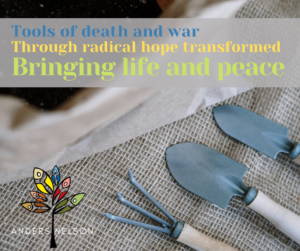
Tools of death and war
Through radical hope transformed
Bringing life and peace
-Anders Nelson
Through radical hope transformed
Bringing life and peace
-Anders Nelson
*image description: photo of gardening tools and soil with the words: Tools of death and war, Through radical hope transformed, Bringing life and peace
Queer Scripture Reflection: “Fabulous Joseph” by Deacon Lewis Eggleston
 Recently, I had the extreme honor of being cast as Joseph in the musical Joseph and the Amazing Technicolor Dreamcoat. It’s been an absolute joy to tell this story while singing some of the most tremendously campy & heartfelt songs. I must admit, I never really took the time to take a deep dive into Joseph’s story. In my studies, Joseph’s story was generally glanced over between the multiple creation stories, Noah & Abraham, and then I was in a gallant rush to study Exodus. For as many chapters in Genesis that Joseph’s life story entails, you could imagine it would have a more considerable demand for study or intrigue. Yet, unlike Joseph’s dreams which are jam-packed with interpretative opportunities, the rest of the story is seemingly cut and dry.
Seemingly…
As queer people all know, historians love to explain away the queer bits in history.
Joseph’s coat, for example, the specific Hebrew phrase is k’tonet passim seen only in one other place in the Bible, which describes King David’s daughter, Princess Tamar’s striped tunic dress. So after having been given this lavish garment (dress?) by his father, Jacob, we can begin to see the familial cracks growing between Joseph and his eleven brothers. Most queer people, raised to act masculine, could easily imagine what would happen if their eleven brothers watched on while you fabulously pranced around the living room in your colorfully ornate princess garment. Tragically, this becomes a mixed bag for Joseph, as Rabbi Greg Kanter put it:
“Chosen to wear fabulous clothing. Rejected by his family. Kicked out. Sent to prison for refusing sexual advances. Succeeds despite society’s attempts to bring him down. Dramatic coming out scene. Beloved by his family when they realize he has something to offer (always had, but).”
Queer people know this story. It is familiar and intimately felt today, despite us being separated from this story by 3700 years. Another beautiful part of Joseph’s story is that God seems to encourage & reward interpretation. Seeing & interpreting a small part of myself alongside Joseph’s story is a beautiful and faith-uplifting experience- whether or not Joseph is or was part of the “queer family”- (which I believe he is), I still sense & comprehend similar experiences (albeit with a mere fraction of his hardships) while believing that God is there in the pit with Joseph- with me- with you.
Joseph’s story is a reminder that people cause significant harm, yet God is there making new possibilities for Joseph- in the pit, in prison, and even in reuniting a broken family. Hope remains, and may we always look & remain as fabulous as Joseph.  Deacon Lewis Eggleston (he/him) is the Associate Director of Communications & Generosity for Extraordinary Lutheran Ministries. He lives with his husband and pup in Kaiserslautern, Germany and will soon move to Washington D.C. in May of 2023. He is excited to spend the entirety of this weekend preparing the house for Christmas!
ELM Blog: Queer Scripture Reflection- Love & Loss by Margarette Ouji
Ruth 1:16-19
I attended college at a small conservative Lutheran school. Ironically, I stepped into my queer identity in that place. I also learned too much about death too quickly. At least it felt that way at the time. I lost a friend after my first year of college and in the wake of his death, I saw queer love evolve and become a life-giving force that would sustain me, to this day.
Ruth and Naomi’s journey together is one filled with grief, vulnerability, and palpable queerness. They have both lost people they love dearly. *insert the Les Misérables lyrics: there’s a grief that can’t be spoken…there’s a pain goes on and on.” Naomi could go the journey to Bethlehem alone. She had already traveled from there to Moab. Ruth wouldn’t have it that way.
As queer people, we are often forced to navigate our losses alone. In a world, and in a church, that remains on the fence about how it “feels” about us, the grief we experience can be complicated…and one loss is never only one loss. It flings wide the gate of every loss we have ever known and invites it to come rushing in. I think many of us would be just fine as Naomi. Journeying back to a place we’re familiar with, comforted by the illusion of safety, and carrying our grief alone. Sometimes it takes persistence from someone like Ruth who says, “I swear to you: Where you go, I will go.” Queer friends, we’re worthy of that kind of accompaniment, though it is easy to forget.
Since my friend died seventeen years ago, I’ve been Naomi, and I’ve been Ruth, depending on the season. Queerness makes space for that: for becoming, shifting, and evolving.
My small conservative Lutheran school gave me the queerest gift: relationships like the one of Naomi and Ruth. They were people that redefined for me what family and home can be. We made similar promises to one another of not dying alone. My friends’ parents’ homes became my home. “I Will Follow You into the Dark” by Death Cab For Cutie became our love letter to each other.
I pray that everyone who reads this knows a queer love like that of Naomi and Ruth. May those around you help hold the grief and the love, together. May you be blessed by the expansiveness of being held in the queerest of ways. If you are more like Naomi, may you be open to not going the journey alone. If you are more like Ruth, may you be open to the same love you give. If you are somewhere in between, as I imagine many of us are, may all of your journeys be filled with love that is ever widening, hearts that are ever softening, a sense of belonging that is as persistent as Ruth, and a willingness to receive it all, like Naomi.
 Rev. Margarette Ouji (she/they) serves as pastor at First Lutheran Church of Montclair, NJ, and serves as co-chair of the ELM Board of Directors. They are the first Iranian-American pastor ordained in the Evangelical Lutheran Church in America. Margarette loves spending time with her family and exchanging queer love letters in the form of playlists.
Queer Scripture Reflections: Loving Leviticus by Rev. Aaron Decker
Sometimes I think something is wrong with me. Considering my queerness, perhaps serving the Church is a mistake. This institution has hurt me and our whole community. Why be part of this religion? Yet we come in droves.
I suspect we do not have much choice. The calling is sufficiently profound to be inescapable. We can resist it, avoid it, reject it… and still end up in its midst. If traditional ministry won’t accept us, we find something even more complicated and irresistible. Here we stand; we can do no other.
I wonder if ancient Aaron felt the same. God proclaimed him chief priest over Israel and his descendants forever. How must it have been to be the first ordained, blood ritually smeared on his ear and thumb and toe? What fear when he crossed into the curtain-covered confines of the Holy of Holies, entering the physical space of God’s presence to cleanse it from the defilement that imperfect humanity made accrue?
“Will this kill me?” And crossed the boundary anyway.
So many rules. Aaron understood skin rashes, discerning necrosis to ward off death enfleshed. He learned which foods sustained life, and lead to death, or trafficked in death, or looked like death. He performed rituals to remove the stain of death from the community so life could spring forth anew.
This is what Leviticus is about. The world contains fearful boundaries. The most dangerous separates the normal, profane world and the holiness of God. Or another way, it is the line between death and life. Humanity is caught up in death; God is the source of life. God’s holiness radiates outward from his home in the temple, making Israel (and all humanity in turn) holy and alive. “You will be holy, just as I your God am holy”: not a command but a proclamation! And so Israel’s priests navigate the boundaries with care to ensure that the entire universe does not fall off the edge.
Aaron’s descendants became priests because they were created in his lineage. Sex and gender minorities become priests because we are created to embody boundaries. Society demarcates male and female; we live in the space between. Love is defined narrowly; our existence transgresses the definition. We experience death in the mundaneness of life and find life in the playfulness the world thinks is death.
So many read Leviticus and condemn. But queer folx are the living embodiment of Leviticus-life. We navigate profanity and holiness so the profane world may be holy, just as the God we love is holy. It is our vocation. It is inescapable.
Almost as inescapable as the queerest boundary crossing in all eternity: Holiness become flesh, death become life, crucifixion become resurrection, drowned in Baptism and risen again in Jesus, our dearly and queerly beloved, love-transgressing, highest high priest.
 The Rev. Aaron Decker (he/him) identifies as a word-sexual, story-romantic, bilingual-positive cis-nerd. He serves as a theological educator with ELCA Global Mission, working to build a Lutheran seminary in South America, where he lives with his cat, Moses.