|

|

|
|
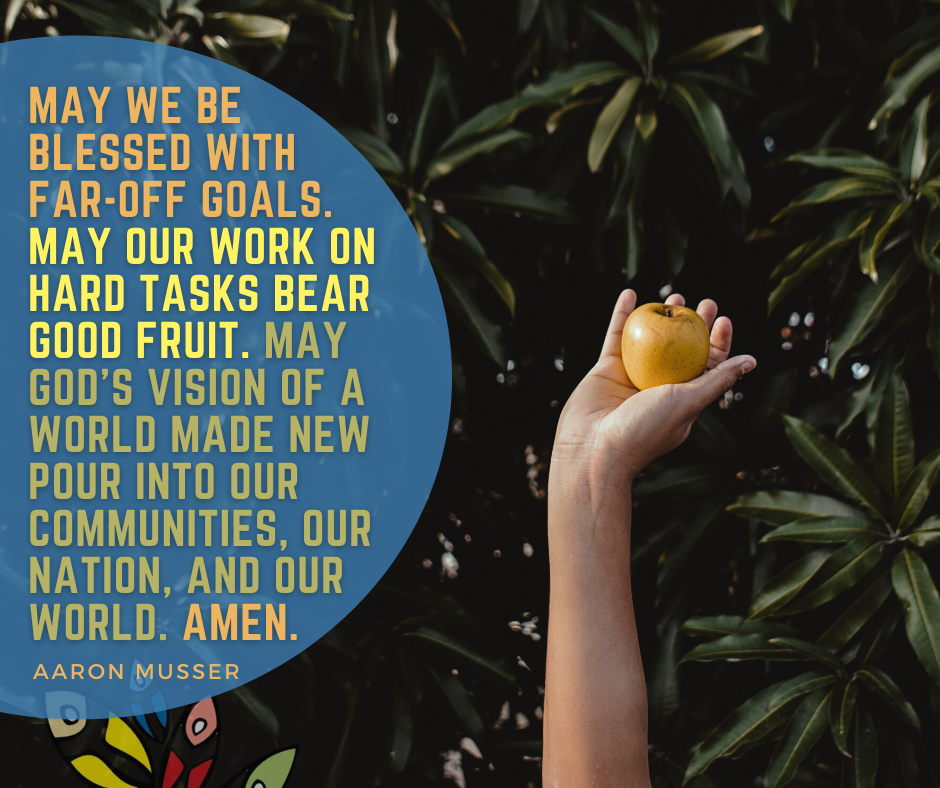 Third: Show us a vision of world made new. Even when we aren’t sure if “a world made new” is possible. Even when our ability to cast new visions is exhausted.
 Aaron Musser (he/him) is a second-year MDiv student pursuing ordination in Word and Sacrament at the Lutheran School of Theology at Chicago. Before seminary he served in Milwaukee, WI as a church musician and music educator. He finds joy in natural things, in queer performance art, in beautiful music, and in cherry chocolate chip ice cream.
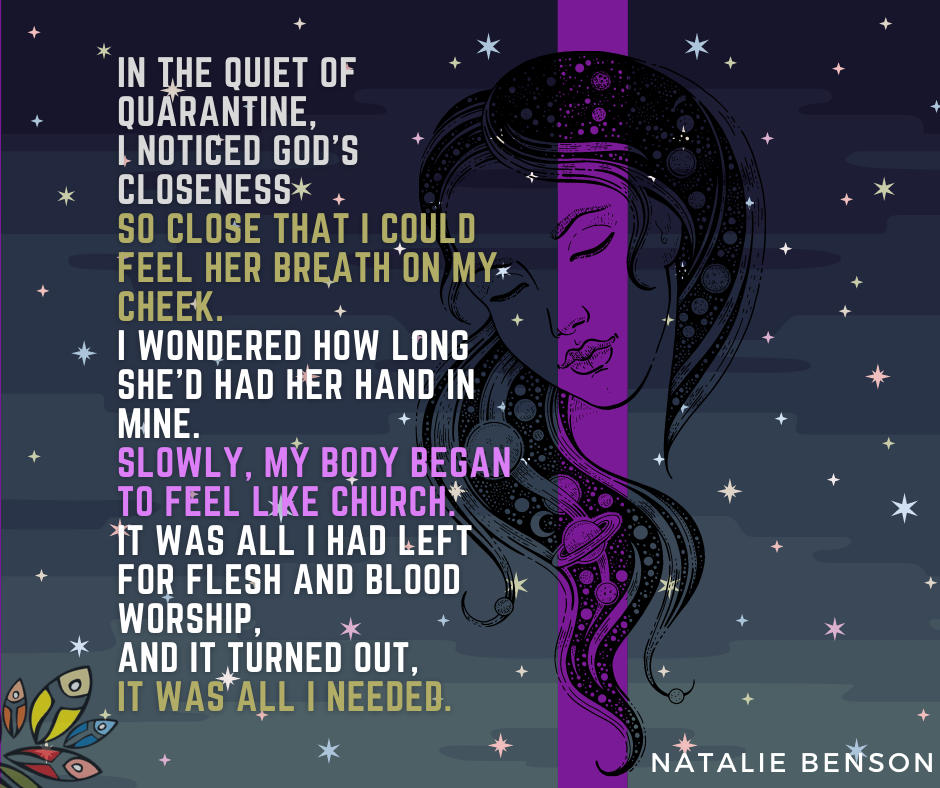 But strangely, I felt held. Not by the God who expected a perfectly executed Lenten season, but by the God who met me in places I didn’t expect. This God held the frantic scribbles in my journals, my defeated body that couldn’t muster the energy to pull itself up off of my bedroom floor, and my midnight whisper to the sky one night – “I think I’m gay.” In the quiet of quarantine, I noticed God’s closeness – so close that I could feel her breath on my cheek. I wondered how long she’d had her hand in mine. Slowly, my body began to feel like church. It was all I had left for flesh and blood worship, and it turned out, it was all I needed.
 Natalie Benson (she/her) is a third year Master’s of Divinity student at Yale Divinity School and an aspiring university chaplain. A proud Midwesterner- Natalie grew up in Bloomington, IL and later went to the University of Indianapolis, where she studied Psychology and Religion. In college, she discovered a deeper connection to her Lutheran faith through interfaith dialogue. If ministry doesn’t work out, Natalie would be happy living on the beach and enjoying her new-found love for surfing.
Extraordinary Lutheran Ministry is pleased to announce that seminarians Rachel E. San Diego (she/hers) and Jory Mickelson (he/they) have been selected as the 2022 Joel R. Workin Scholars.

Rachel attends Pacific Lutheran Theological Seminary in Berkeley, has been recommended for ministry by the Sierra Pacific Synod and is currently an intern at Immanuel Lutheran in Seattle, Washington.
Jory is an MDivX candidate at Luther Seminary, has been  recommended for candidacy for the Northwest Washington Synod and is currently an intern at Christ Lutheran in Ferndale, Washington.
Committee Chair Michael Nelson writes: We had a dozen wonderful candidates this year –the most ever – but Jory and Rachel were the voices that we felt best honored and embodied the ongoing witness and legacy of Joel Workin.
Rachel’s sterling resume reveals a breadth of experience and steady commitment to the marginalized, as well as her work on multiple justice issues, including victims of violence. In her reflection on Joel Workin’s essay (entitled “Overflowing” which cites moments of God’s “Yes, Period” and “No, Period,” in one’s life and ministry) Rachel rousingly writes, “There is not enough white paper that could contain the stories of “No, period” that my Brown body holds.” Later, she concludes that she “was bathed in the waters of sacredness of (her) experience … (that she has found) “Yes, period” showing up in community, in grace, and in the Holy waters between us.”
Among many other accomplishments, Jory’s resume reflects their service to the church and notes that he is the recipient of the 2020 Grace Award from the Northwest Washington to serve the LGBTQIA+ community in Whatcom County. Their elegant essay was marked with insightful moments with phrases like this: “Queer people’s gift to the church is one of rupture and disorder. LGBTQIA people ruptures the silence of what God’s people fear to speak aloud and attempt to hide away. Ruptures our private spiritualities into public faith. Ruptures the barrier that church walls have become and lets in the world.”
On behalf of the committee, I congratulate each of the twelve fine candidates and pray they will continue to bear witness and ministry to the LGBTQIA+ community for years to come.
Each year ELM names a Joel R. Workin Memorial Scholar to honor the life and ministry of Joel Raydon Workin. Joel was one of the three seminarians who were refused ordination in 1989 after coming out to their candidacy committees. Upon his death, Joel’s parents, Ray and Betty, and other family and friends created the scholarship fund in his name to keep his prophetic voice part of the movement. The scholarship is available for all members of Proclaim who are preparing for rostered leadership in the Lutheran church. This year’s award comes with a $7400 award for both Rachel & Jory.
Extraordinary Lutheran Ministries organizes queer seminarians and rostered ministers, confronts barriers and systemic oppression, and activates queer ideas and movements within the Lutheran Church.
To learn more about the Workin Scholarship click here.
To read Jory and Rachel’s essays, click the links below.
Joel Workin Scholarship_Rachel San Diego Workin Essay_Jory Mickelson
|
|
|
|
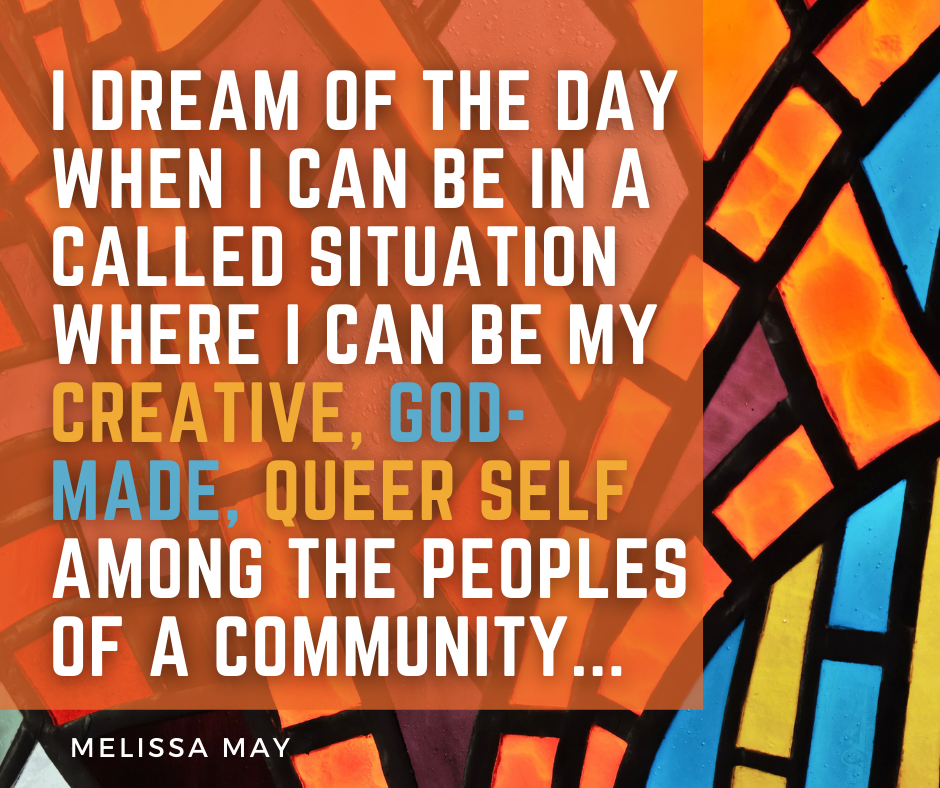
Image Description: Photo of stained glass with the words: I dream of the day when I can be in a called situation where I can be my creative, God-made, queer self among the peoples of a community... - Melissa May
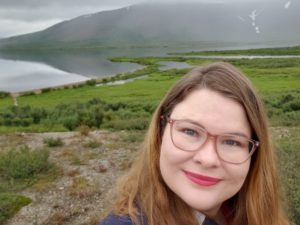 Melissa May (she/her) is a pastor reaching the end of co-leading “Phase 1” of the Virginia Eastern Shore Exploration, a Synodically Authorized Worshiping Community Exploration in the Virginia Synod. She also teaches four English classes at the Intensive English Program at Eastern Mennonite University and one English class with Afghan refugees through Church World Service in Harrisonburg, VA. Her previous two calls were as a congregational pastor in Nome, AK and as a diaconal minister in Yellowknife, Canada.
By: Vica Etta Steel
Let me tell you a story of Call and Coming Out. Let me tell you a story of Love through pain.
I came out three years ago: Woman. Queer. Transgender.
I began my journey into faith leadership just over one year ago.
Until four months ago, I couldn’t pray.
Until four months ago, I couldn’t say the name Jesus. Or God. Not easily.
And yet I heard the call to faith leadership. I’d heard the call my entire life.
And just as I knew my Call young, I also always knew I was a girl. But I learned, by kindergarten, that I needed to hide my truth.
One moment in time:
Laughing with friends, playing dress up.
A mom’s heels too big on our small feet.
Blouses became dresses.
So much laughter.
Then.
Laughter.
An older brother, laughing, cutting at the heart of me.
Only one moment in time.
One, of too many.
God did not err with me. Humans erred again and again.
But this story, this story is a story of love.
Love overwhelming. Love, defiant.
I have met hate. And fear. I hear prayer used as a weapon, beseeching God that I cease to exist, in my fullness. They say I am a sin.
My Call story was not permitted by churches – so God gave me a different path. My faith formation came at the hands of atheists, agnostics and spiritual people. I learned of their deep belief in love, in community, in radical welcome of the outcast – values that should have been Christian values, but too often weren’t.
Too often aren’t.
And now I find a home also in faith. I have a path renewed, opened for me by the so many Queer faith leaders who fought, extraordinarily, for places in faith. I know so much of love overwhelming.
I can never thank my elders (even those younger than me) enough.
And I know love, unexpected.
I am welcomed in my local church. Truly.
I am embraced in my seminary. The president, faculty, and the so many colleague students listen, hear, and uplift my Truth and our Queer stories.
In my synod, leadership works with me to begin creating a syond-wide Queer and ally youth led worship/gathering space.
Is that all? Not even my Loves. I feel every bit of hope toward futures that know
only Love.
And so I can begin.
My call story, coming out.
But a beginning is far from an end.
I begin to speak toward truth.
I am not a sin,
but I am a sinner.
I have sinned the sin of silence in the face of oppression. I have sinned the sin of accepting the world as it is. I have sinned the sin of ignoring my broader family of those marginalized. For too long I turned my head from what my Black friends and family told me, that racism still rages.
And I say, no longer. Not for me.
But I know I will fail too. How long, Oh Lord?
Grace lifts me up.
And I learn to pray.
Again.
I pray for guidance to work the joyous work of facing sin directly.
And I learn to speak the divine names of Jesus:
Love. Welcome. Uplift. Radical resistance to the world as it is.
But I also learn to speak the name of Jesus,
fully human.
And I am called, defiantly.
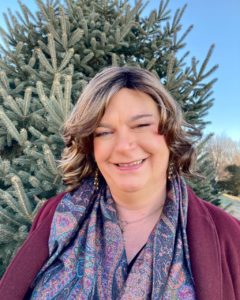 Vica Etta Steel (she/her) is a woman, queer, transgender, and unexpectedly a faith leader! She attends Wartburg Theological Seminary. She preaches and does outreach at St. John’s Lutheran in Madison, WI. She keeps a ministry on TikTok (@vicasteel) where she speaks of the voice of God, never silent and always present in the world around us.
Vica is married to her powerful wife, Stella (36 years come March!). They live with their little dog, Arabella Longbody, their leopard gecko, Snowflake, and many other creatures and plants!
by Margarette Ouji
None of us are “one thing”. At any given moment we can embody so many different identities, and oftentimes, those identities will bump up against one another. If we find ourselves with our family of origin, we are one person. When we are with our chosen family, we are another. In ministry, we can often be a reflection of all of those identities, and still, feel like we cannot be all that we are. This reality of identity hopscotch can be tiresome and unforgiving.
God calls us to be our whole selves and calls us into a loving relationship with those we serve. Sometimes that can be scary and unsettling – especially when so many of us have been told that who we are is not enough or is wrong.
 Pause.
Who you are is more than enough.
You are beloved.
Yet, it can still be scary when we have been told we have to “come out” in order to have this one fabulous aspect of our identity be validated. Have we not spent so much energy hoping and praying and looking for that validation?
In seminary, I took a course on Queer Liberation Theology, and in that course, I learned about the antithesis of “coming out” and it’s called “inviting in”. It’s this idea that instead of sharing your identity with the world, you invite people in to know and love you. I invite you into my home, to share in each other’s lives, to laugh, to eat, etc. (as long as you leave before 8 pm so I can go to bed on time).
It reminded me of how in many Iranian families when you bring someone to your family’s home, you’re welcomed in. I walk into my ameh’s (the word for aunt in Farsi) home, take off my shoes, I’m offered food, I’m guaranteed laughter, tears, and love.
Many of us cannot “come out” for reasons that do not need justification. By inviting people in, by inviting our congregations in, we are acting from a place of love. We are sharing our worlds and all of the identities that we embody.
Recently, I was reflecting on Isaiah 43: 18-19:
“Forget the events of the past, ignore the things of long ago! Look, I am doing something new! Now it springs forth—can’t you see it? I’m making a road in the desert and setting rivers to flow in the wasteland.”
God is doing something new in the ways that we are inviting one another into our lives, our hearts, our congregations. Newness can be scary. It is also so very queer and so very sacred.
Image Description: Photo of field of flowers with the words: Pause. Who you are is more than enough. You are beloved. – Margarette Ouji
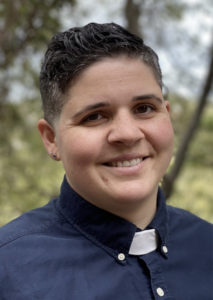 |
Margarette (she/her/hers) is the pastor at First Lutheran Church of Montclair, NJ. She enjoys powerlifting, crocheting, and spending time with family. Margarette currently serves as co-chairperson of the Board of ELM and is passionate about the difficult, necessary, and holy work ELM is doing. |
|
|

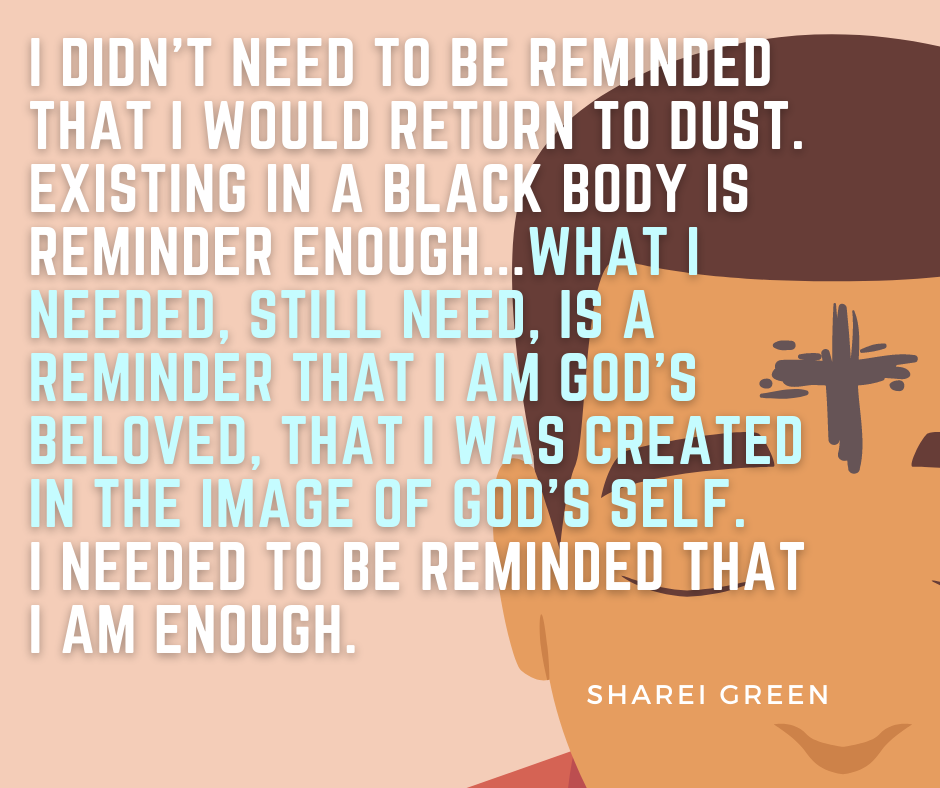
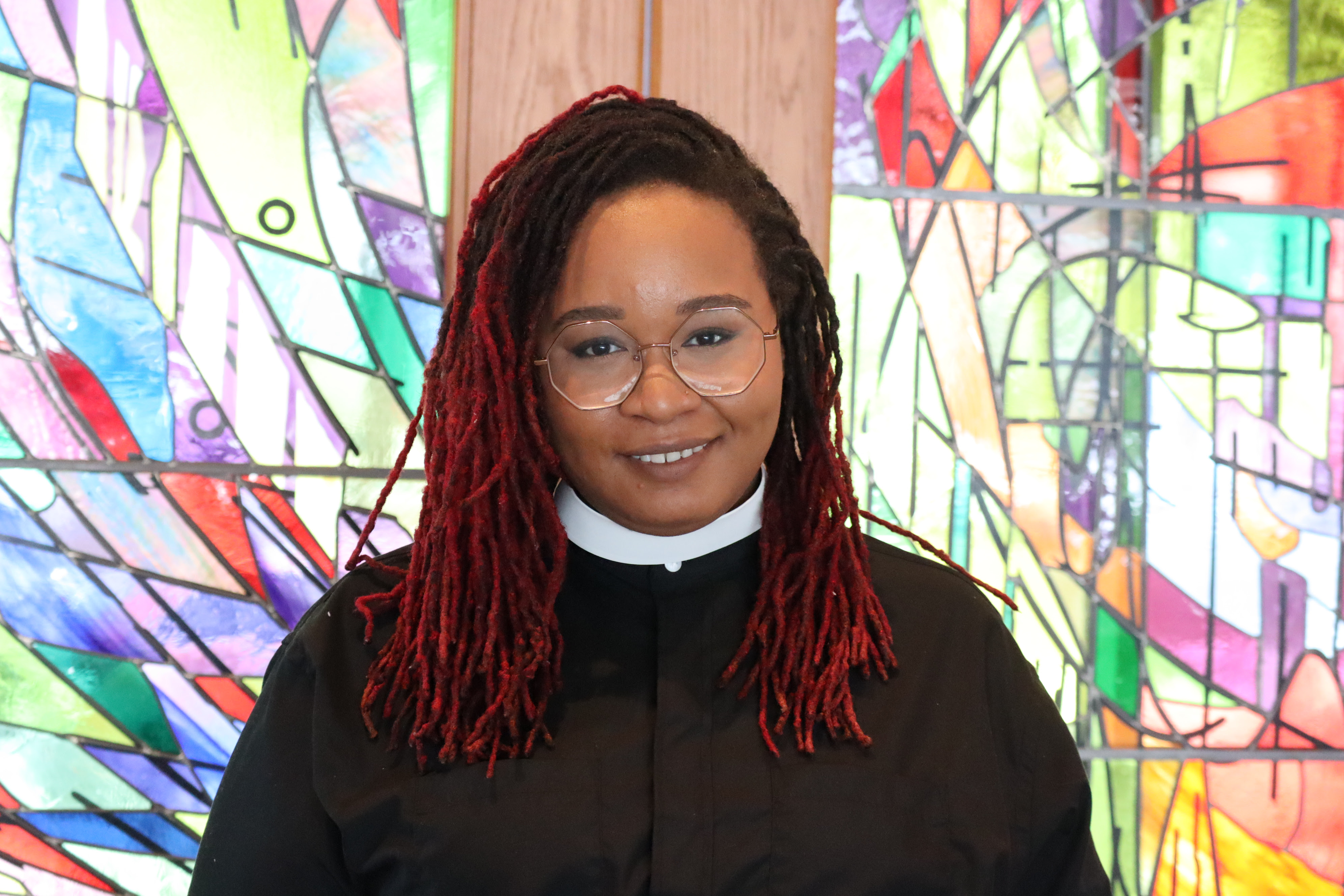 Sharei Green (she/her) is a Womanist theologian currently pursuing her MDiv at the Lutheran School of Theology at Chicago. Sharei has a strong commitment to community healing and sabbath, especially in BIPOC communities and all their intersections. She is the co-author of
 Aaron Decker (he/him) is a Theological Educator in Bolivia with ELCA Service and Justice (Global Mission). He has passions for world languages, textual ambiguity, and education as liberation. He lives with his cat, Moses; like in Exodus, Aaron might talk more, but Moses is definitely in charge.
 Lewis Eggleston (he/him) is the Associate Director of Communications & Generosity at Extraordinary Lutheran Ministries. He is an Air Force spouse living in Germany with his husband and their dog-child, Carla. In March, after spending nearly 10 years in candidacy, Lewis will be ordained into the ministry of Word & Service! *all the enthusiastic emoji faces*